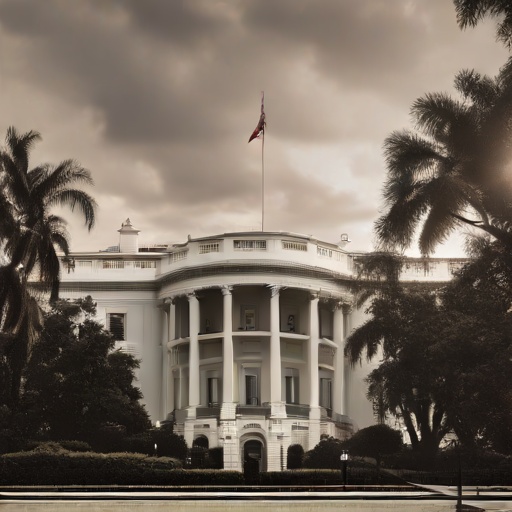
Trump Hosts White House Cage Fights Amid War And Political Scrutiny
Seventeen months into his second term, President Trump's controversial event sparks debate over presidential decorum while critics cite national security concerns.
WASHINGTON — In a move that has sent shockwaves through the corridors of power and ignited fierce partisan debate, President Donald Trump hosted an underground cage fighting tournament at the White House on Tuesday evening. The event, described by administration officials as a display of 'American grit' and physical prowess, marks one of the most unconventional uses of federal property in modern presidential history.
Seventeen months into his second term, President Trump has repeatedly pushed the boundaries of the U.S. presidency to command attention and project strength. Critics argue that staging a combat sport event within the executive mansion trivializes the office during a period marked by ongoing international conflicts and domestic political instability.
A Controversial Spectacle at 1600 Pennsylvania Avenue
The fighting ring was set up in the East Wing, an area typically reserved for press conferences and diplomatic receptions. According to three sources familiar with the logistics, security protocols were significantly altered to accommodate the event, drawing sharp criticism from Capitol Hill Democrats.
President Trump addressed a crowd of roughly 200 guests before the first bout began, framing the fights as a metaphor for the nation's resilience against external threats. 'We are not afraid of conflict,' he stated in an impromptu speech that lasted ten minutes. 'Just like these fighters, America stands ready to defend its values with strength.'
Opposition leaders immediately condemned the spectacle. Senator Elizabeth Warren issued a statement calling the event 'a gross misuse of public resources and a dangerous distraction from real governance.' She noted that while taxpayers fund military operations abroad, hosting cage fights at home signals a disconnect between the administration's priorities and national needs.
White House Press Secretary Karoline Leavitt defended the decision in a briefing later Tuesday. 'The President believes in showcasing American culture and strength,' she said. 'This event was privately funded and strictly limited to invited guests, ensuring no disruption to government operations.'
National Security Concerns Mount During Global Tensions
Security analysts have raised alarms regarding the potential risks of gathering high-profile individuals in a combat-focused environment within the White House complex. The event coincides with heightened tensions involving Russia and ongoing instability in the Middle East, raising questions about threat assessments.
The Secret Service confirmed that additional personnel were deployed to monitor the perimeter but declined to comment on specific vulnerabilities created by the altered venue layout. 'Our primary mission remains protecting the President,' a spokesperson said. 'All events undergo rigorous vetting before approval, more context in Trump Leaves Door Open to National Emergency Declaration Over Voting Rights.'
However, former intelligence officials warn that such gatherings could become soft targets for adversaries seeking to exploit perceived security lapses. Dr. James Carafano of the Heritage Foundation noted that while the event was brief, it sets a precarious precedent for future uses of federal space.
'When you mix violence with politics in the most symbolic building in America, you invite scrutiny not just from opponents but from allies who question our stability,' Carafano explained. The concern is particularly acute given recent cyberattacks on government infrastructure and espionage attempts targeting high-level officials.
Political Fallout And Electoral Implications
The political ramifications of the cage fight event are already rippling through Florida, a key battleground state where President Trump maintains strong support. Polling data from Miami-Dade to the Panhandle suggests that while his base appreciates the boldness, moderate voters remain uneasy about the tone.
In Tallahassee, Republican lawmakers expressed mixed reactions. Some praised the event as 'bold leadership,' while others urged caution regarding its impact on upcoming legislative battles over healthcare and immigration reform. Governor Ron DeSantis, a close ally of Trump, declined to comment directly but emphasized the importance of maintaining bipartisan cooperation.
Florida's real estate market, which often mirrors national sentiment, saw minor fluctuations following news reports of the event. Investors in Orlando and Tampa expressed concern that such controversies might affect tourism confidence ahead of hurricane season preparations later this year.
'This is not just about entertainment; it’s about how we perceive our leadership during critical times,' said Dr. Maria Gonzalez, a political science professor at University of Florida. 'When the President chooses spectacle over substance, it erodes trust among undecided voters.'
As Congress prepares to debate new funding bills for national defense and border security, attention remains fixed on how this incident will influence public perception of the administration's focus. With mid-term elections approaching in several states, every action taken by the White House is now under a microscope.