Inner Party Turf Wars Hang Over Annual Florida Republican Convention Amid Strategic Shift
Byron Donalds and Chairman Evan Power outline plans to paint state Democrats as radicals while navigating internal factional tensions.
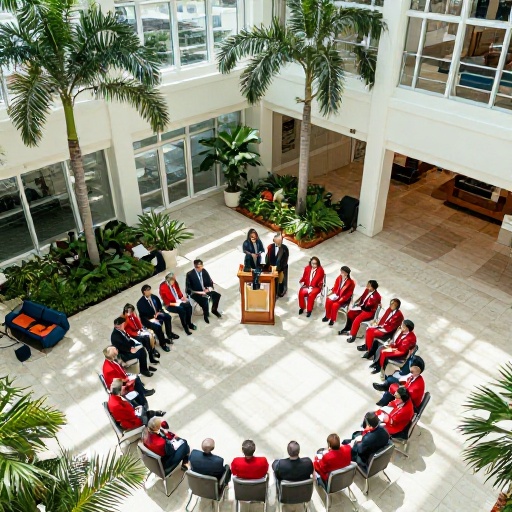
The atmosphere at the annual Florida Republican convention in Tallahassee is charged with a palpable tension, driven not by external threats but by simmering internal divisions. As delegates from every county gather under one roof, long-simmering turf wars between different factions of the party have taken center stage alongside the official agenda.
Despite these internal challenges, state leadership has presented a unified front regarding their primary strategic objective: redefining the political landscape for Florida's moderate Democratic candidates. U.S. Rep. Byron Donalds and State Party Chairman Evan Power articulated a clear vision to frame opposition figures as out-of-touch progressives.
Strategic Realignment Against Moderate Democrats
The core of this year’s platform, championed by Chairman Power during his keynote address, focuses on blurring the lines between Florida's traditional moderate Democratic establishment and national progressive movements. This strategy aims to erode support for incumbents who have historically held sway in swing districts across the state.
"We must ensure that voters understand there is no middle ground when it comes to protecting our families from radical agendas," Power stated, addressing a crowded hall of delegates eager for direction on upcoming primary battles.
Byron Donalds reinforced this message by detailing how the party intends to leverage local issues such as education policy and property rights to paint Democratic candidates as nationalized progressives. The goal is to force moderate Democrats into defending policies they may not personally support, thereby alienating their traditional suburban base in counties like Orange and Brevard.
This tactical shift comes at a critical time for the GOP, which seeks to maintain its supermajorities in both chambers of the Florida Legislature while contesting competitive seats in Congress. The party's data analytics teams are reportedly working overtime to identify voters who have historically split their tickets but may be swayed by this new messaging.
Internal Factions and Leadership Dynamics
Beneath the polished rhetoric of strategic realignment, however, significant friction exists within the party's hierarchy. Reports from sources close to the convention indicate that disagreements over resource allocation and candidate endorsements have created distinct camps among delegates.
Certain factions argue for a more populist approach focused on immigration enforcement as the primary wedge issue, while others prioritize economic deregulation and tax cuts. These diverging priorities have led to heated debates in backroom sessions away from the main stage.
Chairman Power faces the delicate task of balancing these competing interests without fracturing the party's unity ahead of crucial elections. His ability to manage these internal turf wars will likely determine whether the convention concludes with a cohesive message or deepened schisms, a story we covered in Florida GOP Fractured by Data Center Opposition.
The tension is particularly visible in how different groups interpret the state party's relationship with national figures and movements. While some delegates push for strict alignment with federal leadership, others advocate for Florida-specific messaging that distances the state from national controversies.
Economic Implications and Future Electoral Prospects
The outcome of these internal debates will have profound implications for Florida's economic trajectory and electoral map in 2026. The real estate market, tourism industry, and small business sectors are all watching closely to see how the party resolves its differences.
Economic stability remains a top concern for voters across the state, from Miami-Dade to the Panhandle. If the Republican Party appears divided or unable to present clear economic solutions beyond rhetoric, it risks losing ground in key suburban districts that have been trending toward moderation in recent cycles.
Conversely, if Power and Donalds can successfully unify the party around a coherent narrative, they may secure significant advantages in upcoming primaries. The ability to mobilize base voters while appealing to independents will be tested heavily as the convention draws to a close.
As delegates cast their final votes on platform planks and leadership endorsements, the true measure of success for this year's gathering will not just be the speeches given but the strength of the coalition that emerges. The coming weeks in Tallahassee could set the tone for Florida politics for years to come.