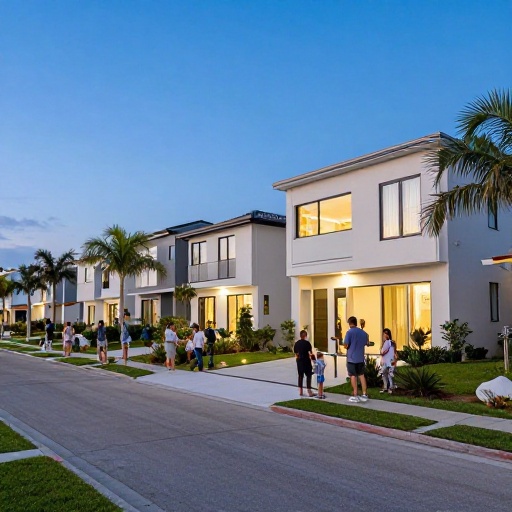
Developers Say Miami Real Estate Still Beats New York Costs
Top builders cite lack of state income tax and lower construction fees as key factors keeping Florida property values competitive against NYC markets.
Top developers operating in both Miami and New York City assert that South Florida remains a significant bargain for investors and homebuyers, despite recent increases in overall costs. According to industry leaders, the mathematical advantages of doing business in Florida continue to outweigh those in New York, primarily due to structural economic differences such as taxation policies and construction overheads.
Tax Advantages Drive Long-Term Value
A primary factor cited by developers is the absence of a state income tax in Florida. This fiscal policy creates a distinct advantage for high-net-worth individuals and corporate entities compared to New York, which imposes one of the highest marginal income tax rates in the nation. For real estate investors, this difference directly impacts net returns on rental properties and commercial developments over long-term holding periods.
While national economic trends have influenced property values across major metropolitan areas, Florida’s tax structure provides a buffer that New York lacks. Developers note that for luxury residential projects and large-scale commercial ventures, the savings generated by avoiding state income taxes can offset higher initial acquisition costs or market volatility in other regions.
Construction Costs Remain Lower
Beyond taxation, developers highlight lower construction expenses as a critical differentiator. Building codes, labor rates, and material logistics in New York City often result in significantly higher overheads compared to South Florida. In Miami, the ability to complete projects with reduced financial friction allows for more competitive pricing or higher profit margins without compromising quality.
Although construction costs have risen nationwide due to supply chain adjustments and inflation, the gap between Florida and New York remains wide. Industry professionals point out that regulatory environments in both states differ significantly, but the sheer volume of cost savings on physical building processes makes Florida an attractive location for new development projects, more context in Florida Officials Honor NYC’s Mamdani With Sarcastic Billboard Praise.
Market Perception vs. Economic Reality
The perception that Miami has become prohibitively expensive is challenged by these underlying economic fundamentals. While median home prices in South Florida have climbed, the total cost of ownership and operation remains lower than in New York when tax liabilities and construction amortization are factored into long-term projections.
Developers argue that this mathematical reality sustains demand for new inventory in Miami-Dade County. As national interest rates fluctuate, investors seeking stable returns with favorable regulatory conditions continue to view Florida as a strategic market. The consensus among top builders is that the current pricing structure does not reflect the full value proposition offered by South Florida’s economic environment.