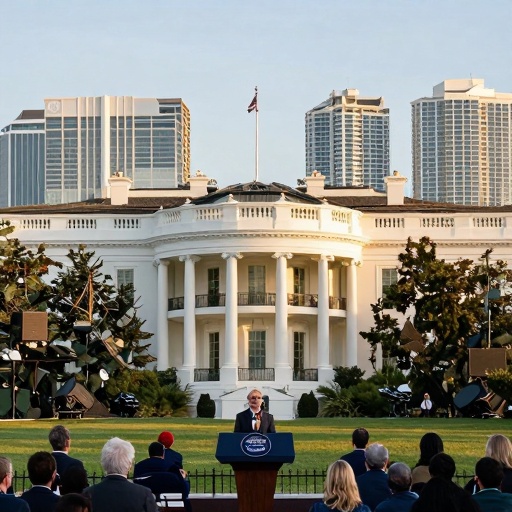
President Donald Trump has publicly stated that the unification of Ireland would be a 'fantastic' outcome, marking a notable shift in American diplomatic rhetoric regarding the region. This declaration breaks with the longstanding precedent established by previous U.S. administrations and official government positions concerning Northern Ireland.
A Departure from Official Neutrality
The United States has maintained an officially neutral position on the question of Irish unification for decades. This neutrality was solidified following the 1998 Good Friday Agreement, which ended much of the violent conflict known as The Troubles in Northern Ireland. Under this framework, Washington typically avoids taking a side that could be perceived as favoring either continued union with Great Britain or full integration into the Republic of Ireland, a story we covered in Trump Arrives in Ireland for Diplomatic Meetings and Golf Visit.
Trump says Irish unification would be 'fantastic.'
The President's recent comments represent a direct challenge to this established diplomatic stance. By explicitly endorsing the concept of a united island, Trump has moved away from the careful balancing act that characterized U.S. foreign policy in the region for over two decades. The specific context or timing behind these remarks was not detailed in available reports.
Historical Context and Regional Stability
Northern Ireland remains part of the United Kingdom, while the Republic of Ireland is an independent sovereign state. The 1998 peace deal created a power-sharing government in Northern Ireland and established mechanisms for cross-border cooperation between Dublin and London. American neutrality has historically been viewed as essential to supporting these fragile political structures without imposing external pressure on either side, a story we covered in Trump Map Suggests U.S. Expansion Into Canada, Mexico and Greenland Amidst Polit.
While the U.S. role often involves facilitating dialogue rather than dictating outcomes, this latest statement suggests a more overt preference for one potential future scenario over another. The implications of such a shift in tone are significant given the complex historical and cultural ties between Washington and both Dublin and London.