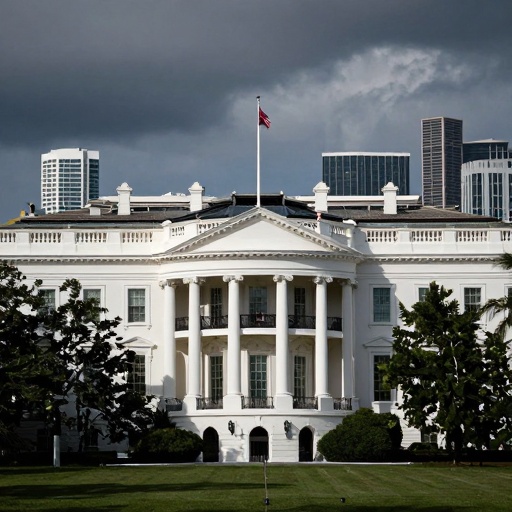
President Donald Trump has publicly suggested that he issued standing orders for the U.S. military to attack Iran if he is assassinated, asserting that "1,000 missiles are Locked and Loaded" against the Islamic Republic. However, legal experts and constitutional scholars clarify that the United States does not possess an automatic, preauthorized "dead man's switch." Under current law, any retaliatory action would require authorization from Vice President JD Vance, who would instantly become commander in chief under the 25th Amendment and the Presidential Succession Act of 1947.
Constitutional Authority vs. Standing Orders
The U.S. government maintains extensive contingency plans for continuity of government during major catastrophes, including nuclear attacks that could wipe out leadership in Washington. Despite these preparations, there is no mechanism to automatically launch retaliatory strikes upon a president's death. Garrett M. Graff, author of "Raven Rock: The Story of the U.S. Government’s Secret Plan to Save Itself," stated that the country has never utilized a technical dead man's switch for nuclear launches.
During the Cold War, the U.S. kept airborne command posts flying 24 hours a day with generals aboard who could assume control if Washington were lost. Graff noted that Trump’s comments likely refer to leaving standing orders for standard launch protocols rather than an automatic trigger. He emphasized that such standing orders are subject to legal doubt because nuclear launch authority passes immediately to the successor, who must determine whether to proceed.
Escalating Tensions with Iran
The remarks come amid heightened tensions following U.S. and Israeli strikes in late February that resulted in the death of Iranian Supreme Leader Ayatollah Ali Khamenei. His son, Mojtaba Khamenei, stated on state television that retaliation is "the will of our nation" and must be carried out to avenge his father's killing. Mourners at recent funeral events held banners calling for the deaths of President Trump and Israeli Prime Minister Benjamin Netanyahu.
The Wall Street Journal reported earlier this week that Israel alerted U.S. officials to fresh Iranian plots targeting Trump. During NATO summit meetings in Turkey, Trump referenced these threats, stating, "They want to take out the U.S. leader — me." Sabrina Singh, a former Biden administration deputy Pentagon press secretary, described such intentions as credible threats that must be taken seriously, more context in Trump Contradicts Top Advisers on Iran War Strategy Amid Rising Tensions.
Security Concerns and Historical Precedents
President Trump was targeted in two domestic assassination attempts during the 2024 campaign. Security concerns were further raised when he flew back from Turkey on an older Air Force One jet retrofitted at a cost of $400 million, which lacks some missile detection systems found in newer models.
While public declarations of personal targeting are rare for U.S. presidents, the Biden administration previously warned Iran in 2022 that attacks on Trump would be considered acts of war. National security briefings often disclose credible threats from foreign adversaries through classified means, but this instance marks a notable deviation by addressing them publicly.