Trump Casts Mail-In Ballot in Florida Special Election While Pushing to Restrict Absentee Voting
The president voted by mail in a Palm Beach County state House race even as he publicly equated mail-in voting with cheating
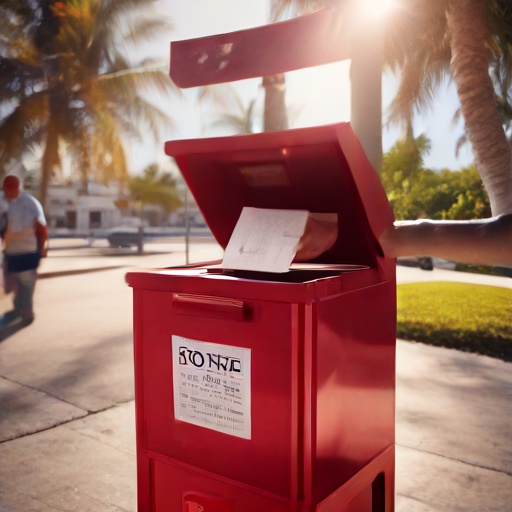
President Donald Trump voted by mail in a Florida special election on Tuesday, a move that stands in stark contrast to his ongoing campaign to sharply curtail absentee voting across the nation. The president cast his mail-in ballot in a Palm Beach County state House race even as he declared just one day earlier that "mail-in voting means mail-in cheating."
The apparent contradiction has drawn scrutiny from voting rights advocates, Democratic lawmakers, and political observers who say it underscores the disconnect between the president's personal behavior and his public rhetoric on election integrity.
A Special Election in Palm Beach County
Tuesday's election was a special contest for a seat in the Florida House of Representatives, triggered by a vacancy in the district that includes parts of Palm Beach County — the same area where Trump maintains his official residence at Mar-a-Lago. As a registered Florida voter, Trump was eligible to participate in the race.
According to Palm Beach County election records, the president opted to vote by mail rather than appear in person at a polling location. The White House confirmed that Trump submitted a mail-in ballot for the special election, though officials did not elaborate on why the president chose that method over casting his vote in person.
The decision to vote absentee is not unusual for Trump, who has a documented history of using mail-in ballots in Florida elections. He voted by mail in the state's 2020 primary and has done so in prior local contests as well.
"Mail-In Voting Means Mail-In Cheating"
What makes this instance particularly noteworthy is the timing. On Monday — the day before submitting his ballot — Trump took to social media to rail against absentee voting, declaring that "mail-in voting means mail-in cheating" and calling for sweeping federal restrictions on the practice.
The president has long been a vocal critic of mail-in voting, claiming without providing substantial evidence that it leads to widespread voter fraud. His administration has been actively pursuing federal legislation and executive actions aimed at limiting absentee ballot access in states across the country.
"Mail-in voting means mail-in cheating. We have to get rid of this SCAM once and for all!" — President Donald Trump, in a social media post on Monday.
The push to restrict absentee voting has alarmed election officials in both parties, many of whom argue that mail-in voting is a secure and essential method for millions of Americans — including military service members stationed overseas, elderly and disabled voters, and those with work or transportation barriers.
Voting rights organizations have noted that numerous audits, court cases, and independent investigations across multiple states have consistently found that mail-in voter fraud is exceedingly rare. The Brennan Center for Justice has estimated that the rate of mail ballot fraud is between 0.00004% and 0.0025% of all ballots cast.
Critics Highlight the Contradiction
Democrats and voting rights advocates were quick to seize on the apparent hypocrisy. Several members of Congress took to social media to highlight the contrast between Trump's words and actions, a story we covered in Trump Votes by Mail Again in Florida Amid Anti.
"The president tells the American people that mail-in voting is cheating — and then mails in his own ballot the very next day," said one Democratic strategist familiar with voting rights efforts in Florida. "If mail-in voting is good enough for the president, it should be good enough for every American citizen."
Florida's own election system has long relied on mail-in voting as a key component of its democratic infrastructure. In 2024, more than 4.9 million Floridians voted by mail in the general election, according to the Florida Division of Elections. The state's Republican-led legislature has expanded and defended mail-in voting options for decades, even as national GOP rhetoric has shifted against the practice in recent years.
Florida Governor Ron DeSantis signed legislation in 2021 that added some restrictions to mail-in voting in the state, including requiring voters to request mail ballots more frequently. However, the option remains widely available to all registered voters in the state without requiring an excuse.
The Broader Federal Push
Trump's administration has signaled its intent to pursue federal legislation that could impose strict identification requirements for absentee ballots, limit the timeframe in which mail ballots can be returned, and potentially restrict which voters can qualify for absentee voting. Some proposals under discussion in Congress would mandate that mail-in voting be reserved only for voters who can demonstrate a physical inability to vote in person.
Such measures would represent a significant departure from current practice in most states. According to the National Conference of State Legislatures, 35 states and Washington, D.C., currently allow any registered voter to vote by mail without providing an excuse.
Election administrators across the political spectrum have warned that drastic changes to mail-in voting could disenfranchise millions of legitimate voters, create logistical chaos at polling places, and disproportionately affect rural communities, seniors, and people with disabilities.
What Comes Next
The special election results in Palm Beach County are expected to be certified in the coming days. Regardless of the outcome of the race itself, the broader debate over mail-in voting appears certain to intensify as the 2026 midterm election cycle approaches.
For now, the image of a president denouncing mail-in voting one day and casting a mail-in ballot the next is likely to become a recurring talking point in the national conversation about election access and integrity — a debate that shows no signs of slowing down.