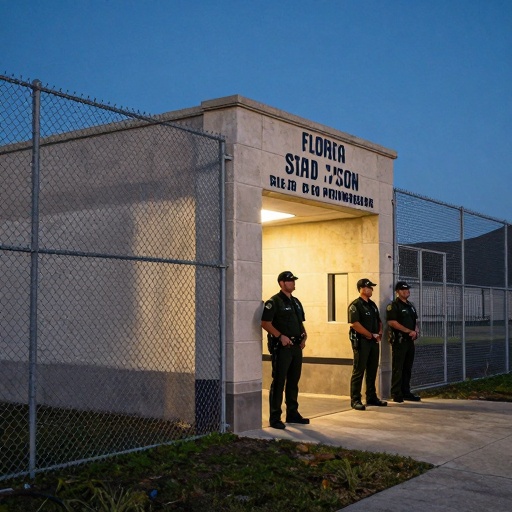
Florida’s approach to capital punishment has undergone significant transformations over nearly two centuries, evolving from public hangings conducted by county sheriffs to the modern use of lethal injections. The state is approaching a bicentennial milestone since its first known execution in 1827, yet recent years have seen an unprecedented acceleration in death warrants under Governor Ron DeSantis. In 2025, Florida executed 19 inmates, setting a new single-year record that far exceeds the pace of any other U.S. state.
Early History and the Electric Chair Era
The origins of capital punishment in Florida were decentralized until the establishment of formal penitentiaries following the Civil War. Benjamin Donica became the first known person executed in the state in 1827, hanged for murder according to archives from the Florida Department of Corrections. The state’s first penitentiary was established at Chattahoochee in 1868 under Governor Harrison Reed.
In 1923, public hangings were abolished as electrocution became the official method. Inmates constructed the first electric chair from oak, which gained the nickname "Old Sparky." Frank Johnson, also known as Luther Dorrill of Duval County, was the first person executed in this device in 1924. The era saw significant activity between 1941 and 1942, when Florida recorded a record of 11 executions per year.
Legal Hurdles and Shift to Lethal Injection
The death penalty faced major legal challenges in the mid-20th century. Executions halted in 1964 while courts reviewed constitutionality, with Sie Dawson becoming the last person executed for 15 years. The U.S. Supreme Court struck down existing death penalty laws nationwide in Furman v. Georgia (1972), leading Florida to commute 96 sentences and draft new statutes.
Executions resumed after the Gregg v. Georgia ruling in 1976, with John Arthur Spenkelink becoming the first inmate executed during this renewed period in 1979. The method of execution shifted again at the turn of the millennium due to controversies surrounding electrocution incidents involving Jesse Tafero and Pedro Medina. In February 2000, Terry M. Sims became the first person executed by lethal injection.
Recent Record-Breaking Pace Under DeSantis
The pace of executions has accelerated dramatically in recent years. Governor Ron DeSantis issued death warrants at an unprecedented rate starting in 2025, culminating in 19 executions by December 18, 2025. This figure is nearly four times the number executed by any other state during that period, a story we covered in Florida Executes Two Men in Single Day, Marking Historic Pace.
Legislative changes expanded eligibility for capital punishment to include attacks on heads of state and crimes at schools or religious gatherings. The state also authorized alternative methods such as firing squads or nitrogen gas if lethal injection drugs remain unavailable. As of July 2026, DeSantis had issued 14 additional death warrants.
Ongoing Legal Scrutiny
The accelerated timeline has drawn criticism regarding transparency and protocol safety. Amnesty International cited Florida’s rapid use of death warrants in its annual report on global execution rates. Appeals have challenged shortened timelines and the clemency process, with Supreme Court Justice Sonia Sotomayor expressing concerns over state secrecy.
Legal battles continue to define specific cases. Dennis Sochor, executed at age 74, referenced autopsy records indicating flash pulmonary edema in previous executions. Despite these appeals being dismissed, the legal landscape remains active. Dominick Occhicone is scheduled for execution on July 28, 2026, potentially becoming the oldest person executed in state history.