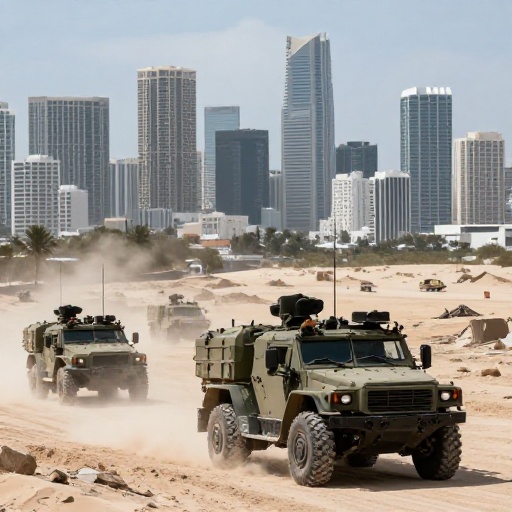
British Prime Minister Keir Starmer and U.S. President Donald Trump have held discussions on the urgent need to reopen the Strait of Hormuz, one of the world's most critical oil shipping lanes, as Israel's military warned that its operations against Iran and Hezbollah could continue for several more weeks. The diplomatic exchange underscores the growing international concern that the escalating Middle East conflict could spiral into a broader regional war with devastating economic consequences.
Hormuz Strait Becomes Central Diplomatic Focus
The Strait of Hormuz, a narrow waterway between Iran and Oman through which roughly one-fifth of the world's daily oil supply passes, has become a focal point of Western diplomatic anxiety. Any disruption to traffic through the strait would send shockwaves through global energy markets and exacerbate inflationary pressures already weighing on economies worldwide.
The Starmer-Trump conversation highlights the transatlantic alignment on the need to keep this vital chokepoint open amid rising tensions with Iran. Tehran has historically threatened to close the strait in response to military pressure, and the current conflict between Israel and Iranian-backed forces has renewed those fears.
While specific details of the leaders' discussion have not been fully disclosed, both the U.K. and U.S. governments have signaled that maintaining freedom of navigation in the Persian Gulf remains a top strategic priority. The talks reportedly also touched on the broader trajectory of the Israel-Iran confrontation and efforts to prevent further escalation.
Israel Signals Extended Military Campaign
The Israel Defense Forces have indicated they are preparing for "several more weeks of fighting against Iran and Hezbollah," a timeline that has alarmed regional observers and humanitarian organizations. The warning suggests that any hopes for a near-term ceasefire are fading rapidly.
Israeli military officials have framed the ongoing operations as necessary to degrade the capabilities of Hezbollah, the Lebanese militant group that serves as one of Iran's most powerful proxy forces. Israel has conducted intensive airstrikes in Lebanon targeting Hezbollah infrastructure, weapons depots, and leadership figures in recent weeks.
The extended timeline has prompted growing fears in Lebanon of a potential Israeli ground invasion. Lebanese civilians in the southern part of the country have been fleeing northward in large numbers, and aid organizations have warned of a mounting humanitarian crisis. The Lebanese government, already dealing with years of economic collapse and political dysfunction, faces an increasingly dire situation.
"The people of southern Lebanon are terrified. They have seen this before, and they know what a ground invasion means for their communities," one regional analyst told reporters, referencing Israel's 2006 military incursion into Lebanon.
Fears of a Broader Regional Conflict
The convergence of the Hormuz Strait concerns with Israel's extended military operations points to a conflict that is rapidly expanding beyond its original boundaries. What began as a series of targeted strikes has evolved into a multi-front confrontation involving Israel, Iran, Hezbollah, and various other armed groups across the region.
Iran's role remains central to the crisis. Tehran backs Hezbollah with funding, weapons, and training, and has itself engaged in direct military exchanges with Israel in recent months. The possibility that Iran could attempt to leverage its geographic position along the Strait of Hormuz as a pressure tactic against Western nations supporting Israel remains a significant concern for global policymakers, as we reported in Trump Reverses Stance on Hormuz Tolls Amid Iran War Struggles.
Energy analysts have noted that even the threat of disruption to Hormuz shipping can move oil prices significantly. Brent crude has already experienced volatility in recent weeks as the conflict has intensified, and a sustained closure or even partial obstruction of the strait could push prices to levels that would strain consumers and businesses worldwide.
Diplomatic Paths Forward Remain Uncertain
International diplomatic efforts to de-escalate the situation have so far yielded limited results. The United Nations has called for restraint from all parties, and several European nations have urged Israel to minimize civilian casualties in its operations. However, the political dynamics in Washington, London, and Tel Aviv suggest that a swift resolution remains unlikely.
The Starmer government has sought to balance its traditional alliance with the United States and its support for Israel's right to self-defense with growing domestic pressure from British voters concerned about civilian casualties in Lebanon and the broader humanitarian toll of the conflict.
For Trump, the situation presents both challenges and opportunities. The administration has positioned itself as a strong backer of Israel while also emphasizing the need to protect American economic interests, particularly regarding energy prices. The Hormuz discussion with Starmer reflects this dual focus.
As the conflict enters what Israeli officials describe as a critical phase, the international community faces the prospect of a prolonged military campaign with potentially catastrophic consequences for the Middle East and the global economy. The coming weeks will likely prove decisive in determining whether diplomatic channels can produce a meaningful path toward de-escalation or whether the region slides further into conflict.